
If you’re familiar with the game discovery community, you’ve probably heard the term “sticky games.” We first heard about this in Ryan K. Rigney’s Push to Talk newsletter, where he talked about the problem of loyal players getting “stuck” in their favorite games, especially live service games. They might dabble in a similar aesthetic, gameplay system, or new release from the same publisher/developer, but ultimately they return to the comfort of their favorite series (why? Read Ryan’s full newsletter above for possible reasons). These troublesome games are usually older titles that lock in a fan base and hinder the efforts of new entrants to enter the field.
But these older titles don’t completely dominate the gaming space. There are a number of popular titles released over the past few years that have made breakthroughs and earned their own “sticky game” status. In this article, we’ll look at popular games released since 2019 and see which games continue to capture the attention of their fanbase on live streaming platforms week after week.
Key points by Stream Hatchet:
- “Sticky Games” is a game with a high long-tail viewership that allows it to continue to maintain loyal players even with new releases.
- Looking at games released since 2019, we see that AAA live service titles with esports features are the most tenacious
- Are there exceptions to this rule? Gacha game Genshin has more tenacity than expected, but AAA RPGs can’t continue to gain viewership over time
AAA titles and shooters consistently gain viewership over time
For this analysis, we selected a sample of 25 games across a variety of genres, publishers, and audiences to provide the broadest possible picture of stickiness across different types of games (both live and non-live services). What these games have in common is that they were all released between 2019 and 2023. So it’s a new game, but we also have enough data to determine long-term health. Next, we looked at the performance of these games…
- Starting: Average viewing time for the first 4 weeks
- Elapsed time: Percentage of weeks since release that achieved 1 million or more hours of viewing (this 1 million threshold was chosen based on our experience reporting on successful games)
_
By plotting these two metrics against each other, you can get a pretty good idea of which games are hits upon release and which ones stand the test of time.
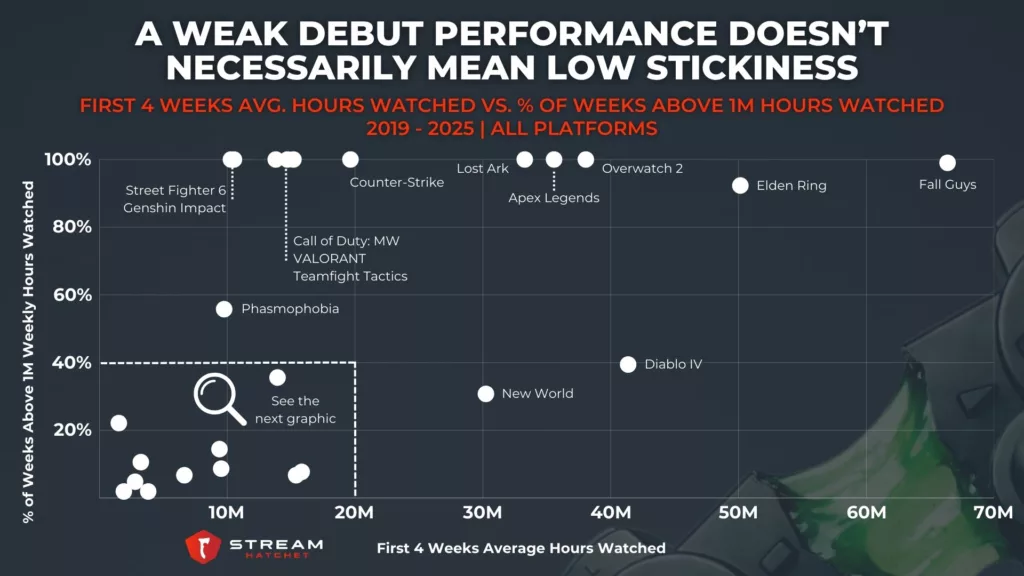
Of the 25 games sampled, nine games have logged more than 1 million hours of viewing each week since release. Interestingly, this long-term success appeared to be independent of the relative success of these titles during their first four weeks. games like overwatch 2 and lost ark Recorded twice the short-term average for games such as: counter strike (Really counter strike 2) and team fight tacticsHowever, they all achieved the 100% milestone.
However, most of the games in this 100% club are sequels to already established series, e.g. street fighter 6, Call of Duty: Modern Warfare). something like an exception gacha game Genshin And MMO lost ark was able to break through by starting with more niche regions (Japan and South Korea, respectively) and retaining these viewers with consistent live service updates. There was one big outlier here too. fall guy It debuted with an impressive average of 66.4 million hours of viewing in its first four weeks, and has continued to log more than 1 million hours of viewing (almost) every week since. But in this instance, pandemic-era viewership growth and the “new” party platformer genre helped raise the game’s profile.
I also wanted to highlight one of the games that pops up in No Man’s Land. Diablo IV has characteristics that ensure long-term success. A sequel to an established series with live service updates. However, despite the game’s launch success (41.4 million hours watched), it has since only surpassed 1 million hours in about 39% of its weeks of release. Our guess is that this has something to do with the relative lack of direct player interaction. Competitive games generate viral interactions that are great for live streaming audiences; Diablo IV The gameplay loop is relatively single-player focused. Additionally, the endgame (where hardcore players spend most of their time) was criticized by the core fanbase upon release.
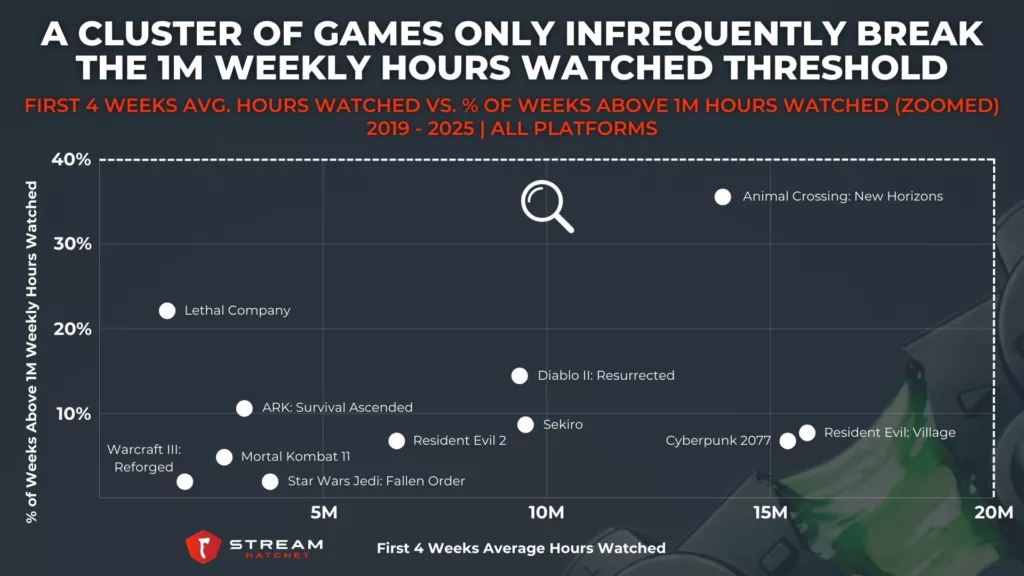
Looking at the spread of games in this sample more generally, there is a clear cluster of games in the bottom left corner. 11 of the 25 games sampled averaged less than 20 million hours watched in the first four weeks, and less than 40% of the weeks since release exceeded 1 million hours. All of the games in this cluster have been commercially successful, but they stand in sharp contrast to the games we’ve discussed so far. These are typically single-player titles with a campaign mode, e.g. ax, resident evil 2), or indie/casual titles (e.g. Lethal Company, Animal Crossing: New Horizons). animal crossing may benefit from the same effects as fall guy However, pandemic-era viewing made it initially a huge success.
Certain genres are more sticky groups (MOBA, shooter) The following sticky groups (survivalhorror), RPG variations are even richer. Some people like it cyberpunk 2077 and new world It has low stickiness (as an MMORPG), but others have achieved high stickiness such as: lost ark and elden ring. lost arkThere’s no doubt that the Amazon connection helped them secure a larger viewership on Twitch. elden ringFrom Software’s prestige as an epic RPG/Souls-like title helps explain why they broke out while other RPGs struggled. But later in this article, you’ll find out that the tenacity of these RPGs may not be as different as it first appears…
You need esports support to get high viewership for weeks in a row
The 1 million threshold is useful for seeing how sticky a game is on average, but publishers of certain types of games want to achieve consistency. Peaks and troughs in your game make it difficult to predictably activate your fanbase when launching new content or hosting community events. So we decided to look at the same sample of 25 games for the longest consecutive weeks of over 1 million hours since launch. We’ve also sorted this data by how this streak compares to the total number of weeks since release to make a fair comparison of games released in different time periods.
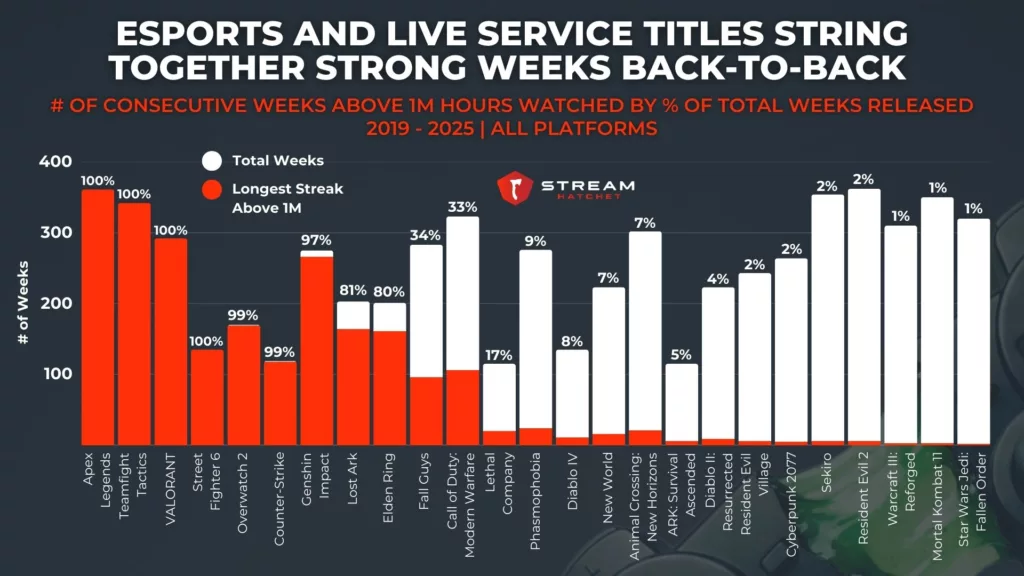
As you might expect, many of the “100% Club” members from the previous graphic rank higher here (note: “100%” may come from rounding, so some games like this) Genshin and lost ark There was actually a small break in the streak). But there’s a clear divide between sticky and non-sticky games. Lethal Company The streak duration has been significantly reduced from over 80% of the total release time to just under 17%. This short streak suggests viewership is being driven by one-time events and the launch of new content. But while viewers pay attention to these events, they quickly lose interest and return to the usual sticky games.
As a general rule, games reach their greatest peak at release and then try to maintain this interest over time, so each game’s longest streak usually begins at release. However, there are rare exceptions. take Lethal Company The game didn’t immediately break out as an indie game, but it gained momentum in its second and third weeks as word of mouth spread.
Sample Normalization: Games Dropped After Successful Launch
The one million hour viewing threshold has its own problems. Using a single metric like this does not take into account the natural differences in popularity between games of different genres and from different developers/publishers. So I decided to look at the data in a different way. This time, we’ll take a look at the performance of these games…
- Starting: Average viewing time for the first 4 weeks (same as before)
- Elapsed time: Percentage of weeks since release that achieved at least 25% of the debut week’s watch time.
_
This new long-tail measure normalizes the sample. This means that games with more hype anyway (usually thanks to AAA’s huge marketing budgets) will be treated on a relative scale.
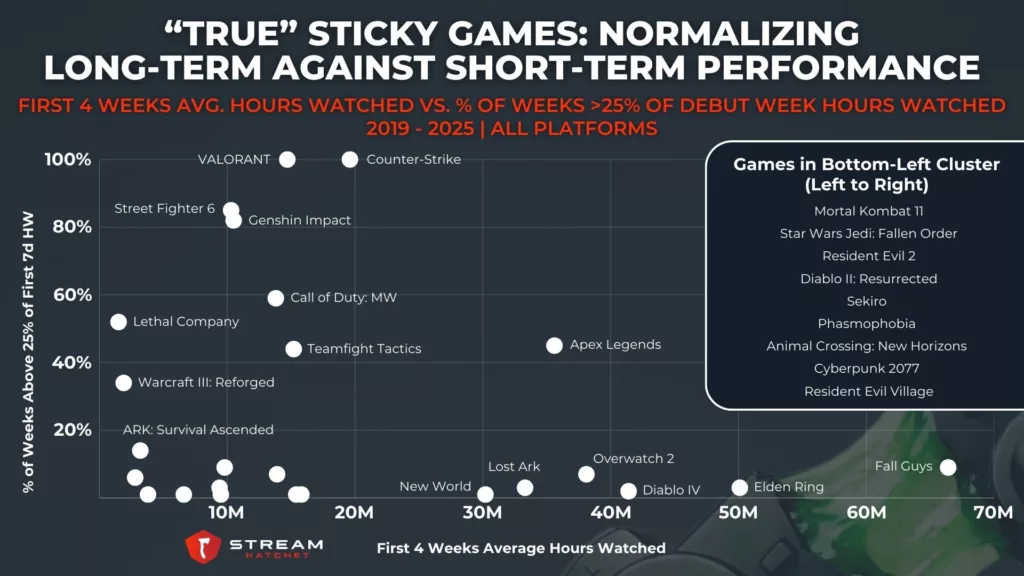
First of all, the difference: If you normalize against early success, you’ll see that RPGs are all on the same level. Where before games like elden ring and lost ark At first glance, it looks like it was sticky, but when you view the data like this, you can see that it still drops rapidly after launch, approaching the stickiness levels of other RPGs such as: cyberpunk 2077. This is not surprising. Players and viewers, no matter how much they like the IP, will eventually run out of story-driven game content and be forced to try new RPGs instead.
Another difference: the left side of graphics (which was initially less popular) has now expanded, with games with notoriously hardcore fanbases moving to the top and games with large but not particularly devoted audiences moving to the bottom. As an example of the former, Warcraft III: Reforged This new metric increases stickiness to 34%, compared to just 2% previously. warcraft Fans have proven their dedication to the world of Azeroth through the extensive modding community. However, as an example of the latter, team fight tactics Under this new metric, club status has dropped from 100% to just 44%. Autofighters don’t inspire fervent dedication like more active titles. And the success of this game mainly depends on the players’ love for the game. league of legends IP.
But for all the differences here, the broader trends remain largely the same. In general, shooters and AAA titles have a more stable position, and games with an esports presence can justify viewers tuning in consistently every week. Assess the value and counter strike (Remember, it’s counter strike 2 Really) are the only two titles to achieve 100% stickiness in both measurements. street fighter 6 Right behind me.
_
Sticky games, whether viewed in absolute viewership (example: 1 million threshold) or relative viewership (long-tail viewership normalized compared to launch viewership), have one quality in common: That is the presence of Esports. You may be thinking, “That’s fine, but my game isn’t suited for competitive play.” But consider this. Actually that’s not the case About It should be a competitive game. Sticky is about having a reliable piece of the title each week to keep the community involved in new developments. Yes, it could be esports, but it could also be community-run events such as: ARC Raiders‘ Battle of Speranza, new content drops Genshinor an active modding community like minecraft.
Additionally, stickiness is a major concern in live service games. Titles that release new editions every year (e.g. EA Sports FC 26), or those trading on a publisher’s legacy (such as titles like From Software’s Soul) must rely on other measures of fan loyalty to see if a new title will garner interest upon release. Stickiness is just one way to create a community, but we personally believe there are many other ways to partner with streamers and leverage the intimacy of streaming to find your own community.
To stay up to date on the latest tips and tricks for building a live streaming audience, follow Stream Hatchet to receive exclusive content only available in our newsletter.
PakarPBN
A Private Blog Network (PBN) is a collection of websites that are controlled by a single individual or organization and used primarily to build backlinks to a “money site” in order to influence its ranking in search engines such as Google. The core idea behind a PBN is based on the importance of backlinks in Google’s ranking algorithm. Since Google views backlinks as signals of authority and trust, some website owners attempt to artificially create these signals through a controlled network of sites.
In a typical PBN setup, the owner acquires expired or aged domains that already have existing authority, backlinks, and history. These domains are rebuilt with new content and hosted separately, often using different IP addresses, hosting providers, themes, and ownership details to make them appear unrelated. Within the content published on these sites, links are strategically placed that point to the main website the owner wants to rank higher. By doing this, the owner attempts to pass link equity (also known as “link juice”) from the PBN sites to the target website.
The purpose of a PBN is to give the impression that the target website is naturally earning links from multiple independent sources. If done effectively, this can temporarily improve keyword rankings, increase organic visibility, and drive more traffic from search results.