
Just a few months ago, we looked at how publishers and brands can combat the inflated live streaming numbers caused by viewbots. Since then, the issue has evolved into one of the defining conversations of 2025. Remember: In late July, Twitch CEO Dan Clancy announced a new wave of anti-viewbot measures, warning creators that their view counts could drop as detection systems kick in. In Q3 2025, Twitch’s market share fell below 50% for the first time in its history, partly due to these crackdowns. Q3 2025 Live Streaming Trend Report. The scale of inauthentic viewership on Twitch was visualized in real time.
Now let’s take a closer look at what this change means in practice. This article details how Twitch’s crackdown has been successful in reducing the number of viewbots on its platform, and how it compares to another live streaming platform, Kick. We’ll also delve into a real-life, current case of Viewbot in the MMORPG Knight Online to show you what Viewbot looks like behind the numbers.
Key points by Stream Hatchet:
- Twitch’s viewbot crackdown resulted in a decline in the number of channels with suspicious streams, by up to 40% in some cases, from Q2 to Q3 of 2025.
- The Viewbot controversy gained momentum before the crackdown, with 48,000 mentions of “Viewbot” in Q1 2025, forcing Twitch’s hand.
- A detailed example of viewbots can be found in Kick’s Knight Online, where 42% of the total viewership of the game’s top 100 streamers belong to questionable channels.
Twitch counters Viewbotting rhetoric with bot crackdown
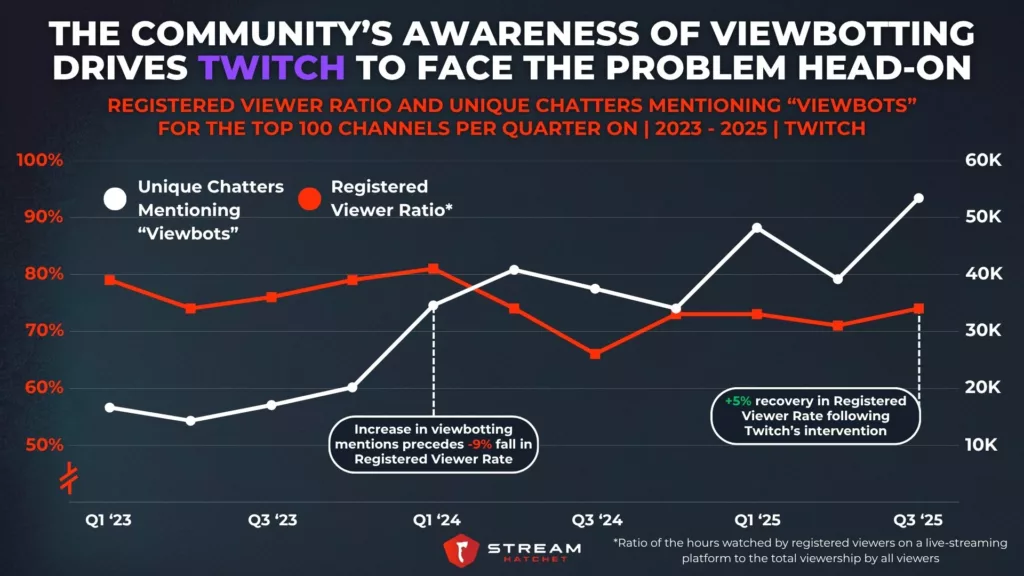
By early 2025, the topic of “viewbots” had taken over Twitch chat. In the first quarter of 2025 alone, 48,000 unique chatters raised this issue. This was a sign that viewers were becoming increasingly frustrated with inflated numbers and fake engagement. However, this increase began in 2024, and the number of mentions steadily increased as suspicions spread throughout the community. Streamers, viewers, and advertisers began to question how inflated Twitch’s viewership metrics were, putting pressure on the platform to take action. By the time Twitch rolled out its detection update in Q3 2025, the conversation had already received 53,000 chat mentions and was one of the defining topics of the year.
We decided to investigate how the noise about bots matches up with actual viewbot activity. One way to measure bots is to look at registered viewership ratings (RVR). This is the percentage of time watched by registered viewers compared to the total number of views by all viewers. When your RVR drops, it means you’re getting more views from unregistered sources (which could be bots). That’s exactly what happened in early 2024, with RVR down 9% as viewbotting chatter peaked. Since then, the situation has managed to recover due to Twitch’s crackdown, with RVR increasing by 5% in Q3 2025. This proves that platforms can curb fraudulent traffic if they act decisively.
Twitch can reduce questionable channels while still standing up when it kicks
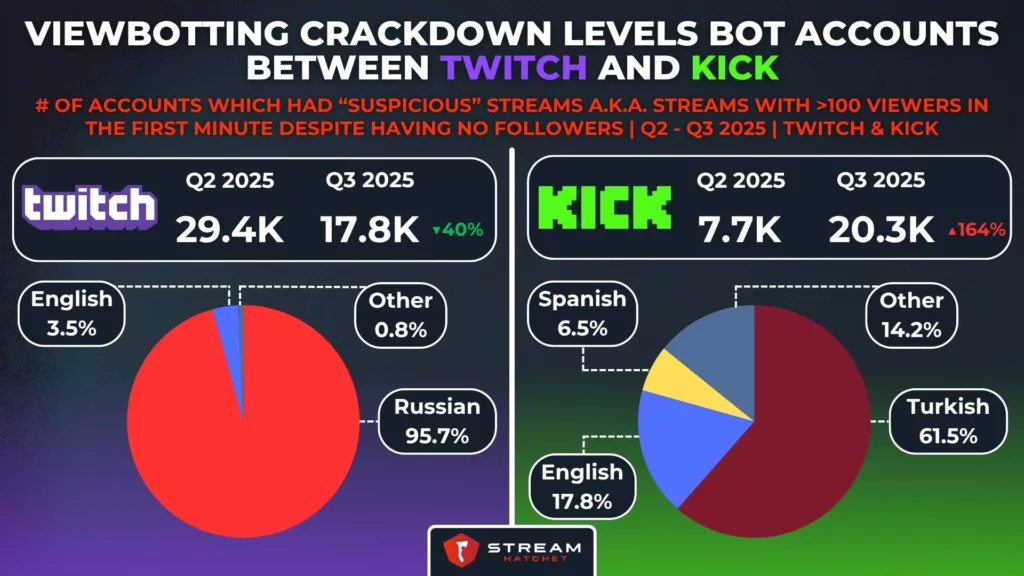
Other metrics can also be used to see the impact of Twitch’s crackdown. We define a “suspicious stream” as a stream that has more than 100 viewers in the first minute, even though the channel has no followers. From Q2 to Q3 of 2025, the number of accounts with these suspicious streams on Twitch decreased by 40%, from 29.4,000 to 17,800. This is a significant change in just one quarter and suggests that the platform’s detection systems are catching more fraudulent streams earlier. Almost all of these suspicious accounts (more than 95%) were on Russian-speaking channels, demonstrating how localized bot networks can be when exploiting platform loopholes.
While Twitch tightened its defenses, Kick showed the opposite trend. The number of suspicious channels on Kick more than doubled, jumping 164% from 7.7K in Q2 2025 to 20.3K in Q3 2025. Turkish accounts dominated this suspicious activity, accounting for over 60% of reported channels, followed by English (17.8%) and Spanish (6.5%). This contrast highlights the increasing fragmentation of bot networks. When one platform is cracked down, others seem to inherit the problem. Kick in particular faces an uphill battle against the Viewbots. This is because, as we’ve explained, the platform is working hard to clean up its images. Let’s take a closer look at a real-world example of what this suspicious activity looks like.
Viewbot example using Knight Online and Kick Channels
night onlinea long-running MMORPG with a strong following in Turkey, has a growing presence on Kick. Unfortunately, this is also a common target for viewbots.
Here I wanted to show you a new way to identify suspicious channels. This is very effective in quickly identifying strange patterns in your audience. For this analysis, we defined “suspicious” channels as those exhibiting an unnatural 1:1 ratio between peak and average viewership. As you can imagine, it is extremely rare (virtually impossible) for any stream to maintain its peak viewership from start to finish. Therefore, we used this metric to investigate the following viewership numbers: night online.
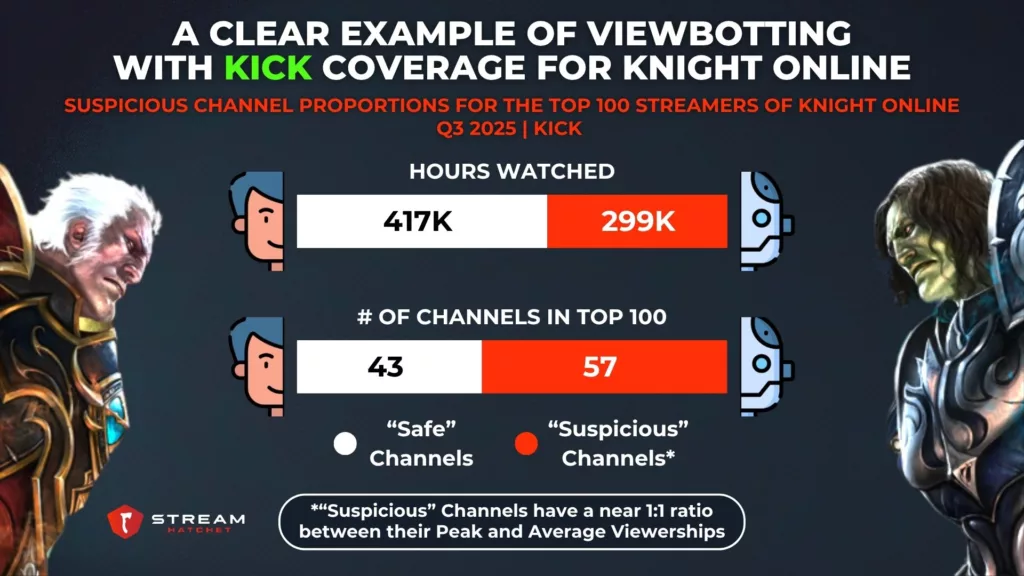
The results were amazing. Kick Channel Top 100 Streaming night online In Q3 2025, 57 channels were flagged as suspicious, more than half of all active channels. These channels accounted for 299,000 hours of the 716,000 total game viewing hours in this cohort, representing approximately 42% of the total audience. This is an incredible number of hours watched over time by a large number of channels with seemingly low ratings. You might think that these channels are just well hidden, but that idea quickly falls apart when a human observer examines the individual channels.
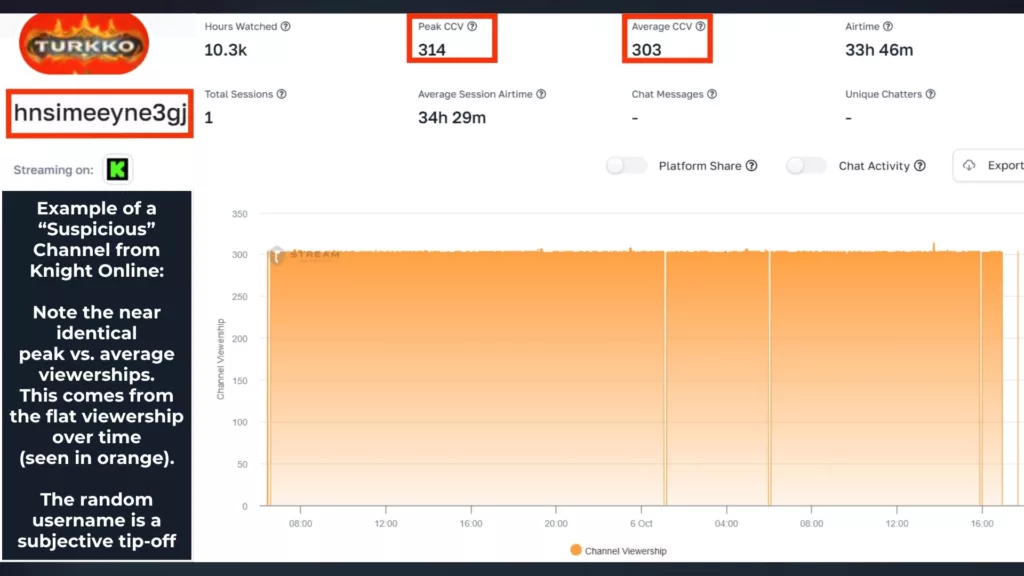
This example dashboard shows exactly what a suspicious channel looks like in practice. Account “hnsimeeyne3gj” streamed night online Kick continued to be watched for over 34 hours straight, but somehow its ratings remained almost completely flat (shown in orange). This is reflected in the channel’s key metrics, where peak concurrent viewers (314) and average concurrent viewers (303) are closely matched (giving the 1:1 ratio mentioned above). Actual viewer numbers naturally fluctuate, but here the numbers hardly fluctuate.
Combined with the randomly generated username and lack of chat activity, it’s clear this is not organic engagement. Instead, it suggests a network of viewbots designed to keep a stream’s viewership locked at a fixed, fabricated level.
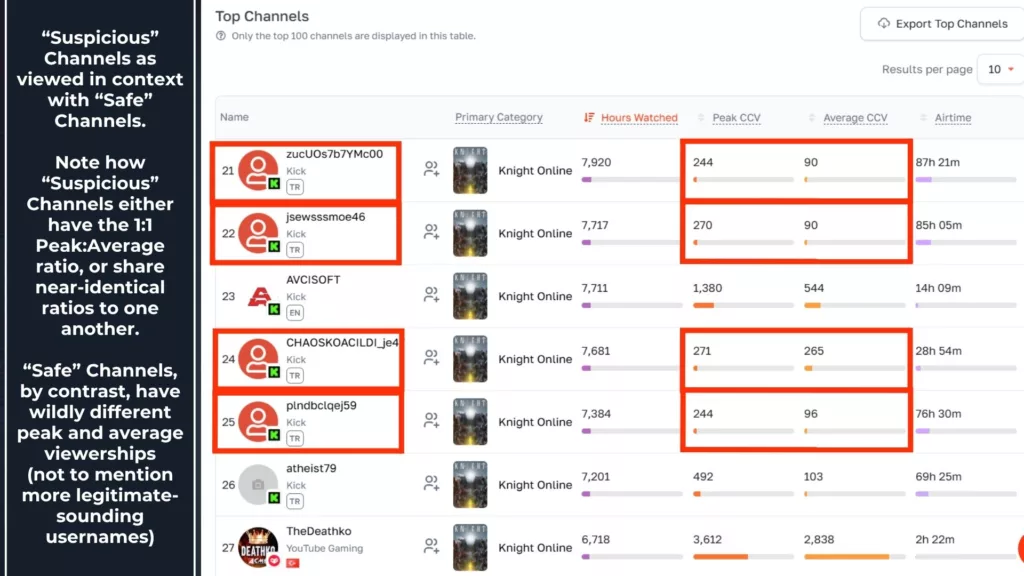
suspicious channel night online Uniformity is also outstanding. Many of these suspicious channels have similar peak-to-average viewer ratings.;For the above channels, the peak CCV is around 250-270 and the average CCV is around 90-100. These carbon copy statistics are a very unlikely coincidence for organic viewers. Combined with random usernames and long airtime sessions, these patterns clearly indicate coordinated or automated viewer behavior designed to manipulate visibility.
Secure channels, on the other hand, tell a completely different story. Peak and average viewership numbers vary widely and reflect the natural ebb and flow of real-world audiences. Engagement spikes during exciting gameplay and interaction moments and then naturally declines. These streamers typically have more authentic usernames, shorter and more varied airtime, and active chat participation. This is a clear indicator of genuine human interaction rather than scripted bot behavior.
We would like to emphasize that this case study is just one example. This is not a special problem night online or kick: This viewbot behavior is also reproduced to some degree in many other titles and platforms, and may not be due to the title or platform itself.
_
Viewbots may never completely go away, but their influence is changing. As the Twitch crackdown has shown, meaningful change happens when platforms face public pressure and back it up with clear enforcement. The decline in suspicious channels on Twitch in Q3 2025 proves that countermeasures are working, either by actually filtering them or driving them off the viewbot network.
But it also reveals the speed with which bots find and adapt to new homes on other platforms. At Stream Hatchet, we aim to maintain visibility into these viewbotified statistics. Using multiple detection methods, from ratio analysis to behavioral signals, we focus on weeding out exaggerated audiences and spotlighting real ones.. That way, publishers, brands, and creators can trust the numbers that will shape the next big activation.
For more trends shaping the live streaming industry in 2025, download the full Q3 2025 Live Streaming Trends Report now.
News
Berita
News Flash
Blog
Technology
Sports
Sport
Football
Tips
Finance
Berita Terkini
Berita Terbaru
Berita Kekinian
News
Berita Terkini
Olahraga
Pasang Internet Myrepublic
Jasa Import China
Jasa Import Door to Door
website focused on news and information about the world of football. This is one of the popular websites in Indonesia accessed by sports fans, especially football enthusiasts, to get quick and reliable information.