
After a surge in subscriptions during the pandemic, year-over-year growth has become difficult for news publishers, forcing them to prioritize retention, move subscribers to higher price points and bundles, and expand their offerings.
Digiday analyzed subscription and paid reader revenue trends for major news publishers that publish these numbers, including the New York Times, Wall Street Journal, Bloomberg Media, Guardian, and Daily Mail.
For many papers, including the New York Times and the Wall Street Journal, growth is not just continuing, it’s accelerating, as is the Guardian’s paid reader submission model. Meanwhile, Bloomberg’s subscription business is showing signs of normalizing after a surge in 2024, and Daily Mail is still ramping up its relatively new subscription business, which launched in the UK in 2024 and expanded to the US and Canada in February 2025.
Rather than lowering prices in the pursuit of growth, many companies lean toward higher-value positioning and introductory offers aimed at converting (and retaining) paying readers. Digiday’s third annual subscription index, based on a cohort of 14 publishers, found that publishers increased subscription prices by 5% in 2025 compared to the previous year. (Bloomberg increased its annual subscription fees by an astonishing 33% year over year, from $299 per year in 2024 to $399 per year in 2025).
“Digital-only total ARPU” [average revenue per user] “Revenue increased to $9.72 from a year ago as we phased subscribers from promotional prices to higher price tiers and increased prices for some subscribers,” Will Bardeen, chief financial officer of The New York Times, said on a Feb. 4 earnings call. “The Times increased its bundle price to $30 from $25 last year.”
As traffic from search and social becomes more volatile, subscriptions have become central to some news publishers’ ability to stabilize their businesses. According to the Reuters Institute’s recent Journalism Trends in 2026 report, subscriptions and memberships remain the top revenue focus for publishers (76%), ahead of display advertising (68%) and native advertising (64%).
Digiday has compiled four graphs showing the subscription status of five news publishers.
Subscriber numbers continue to grow among major news publishers
As the chart below shows, subscription numbers continue to grow despite industry-wide pressure on publisher traffic.
The core of this growth is packaging other areas, newsletters, and premium briefings to increase average revenue per user and reduce churn. New York Times executives frequently cite a focus on strategies that bundle their verticals, such as gaming and cooking, into expensive subscription services and encourage people to subscribe to those bundles as the key to subscriber growth. Bloomberg has added subscriber-only newsletters and videos as added value to its paid service.
New York Times CEO Meredith Kopit-Levien said last year that at least 50% of her subscribers pay for bundled or multi-product subscriptions. “This is important because these subscribers are more engaged, stay longer, and pay more over time.” The New York Times began offering family subscriptions last September, allowing up to four people to join one plan and access news and non-news products. It’s $5 more expensive than a Times all-access subscription.
The Guardian does not have a paywall and instead focuses on attracting readers and raising money around specific news stories and series. I started doing that about 10 years ago. In the US, most of the Guardian’s revenue now comes from reader funding.
Each year, the Guardian reports on digital recurring supporters, including paid memberships, subscriptions and recurring donations. The publisher offers three tiers of monthly and annual subscriptions, and readers can also make a one-time donation.
But this growth among large publishers with strong subscription businesses is not representative of the vast majority of publishers with subscription contracts, according to an analysis by Mother Economics, a digital consulting firm that tracks hundreds of news organizations. In fact, the gap between the two is widening.
Luke Magelko, director of strategy consulting and Peter Doucette, senior managing director of strategy at Mother Economics, said large publishers have the resources to expand their product offerings and monetize demand more effectively, creating daily habits, reducing dependence on the news cycle and leading to healthier subscription businesses. Small publishers face increasing pressure from changing platforms and changing audience behavior, they added.
The median digital publisher had flat subscriber numbers. But among the top 10% of subscription publishers, the number of digital subscribers grew 77% over the same period, according to an analysis by Mother Economics.
According to Mother Economics’ analysis, the median publisher increased digital subscription revenue by about 35 percent, and the top 10 percent increased subscription revenue by 120 percent.
Magiaco and Doucette say the drop in referrals from search isn’t helping, and while Google Discover may be driving more readers to publishers’ articles, viewers who come from search convert to paid subscriptions at about three times the rate of viewers who come from Discover.
The rate of increase in subscribers is also accelerating
As the table above, based on analysis by Digiday, shows, not only are the New York Times, Wall Street Journal, and Guardian increasing their subscription numbers, but their year-on-year growth rates are accelerating starting in 2023. The growth rate expanded by 6-8 percentage points.
The Guardian saw the strongest acceleration in subscription growth among traditional publishers, rising 8.2 percentage points. The New York Times’ growth accelerated by 6.5 percentage points from 2023 to 2025. The Wall Street Journal had a similar trajectory, accelerating by 6.7 percentage points.
But Bloomberg’s subscriber growth has slowed. The year-on-year growth rate decreased from 23.8% in 2024 to 13.1% in 2025, a decrease of 10.7 points. Although still achieving double-digit growth, its trajectory reflects a particularly strong normalization in 2024.
In 2025, Bloomberg changed the way it calculates its subscriber base to focus on active and activated subscribers, rather than adding up a company’s total number of subscription accesses, according to a company spokesperson. They said this better reflects how people engage with Bloomberg through subscriptions.
Publishers squeeze more revenue from readers
As expected, the increase in subscribers also translates into an increase in year-over-year subscription revenue, as the table below shows. (It should be noted that News Corp does not record subscription revenue for the Wall Street Journal in its revenue, but provides a combined circulation and subscription revenue figure for the Dow Jones (which includes the Wall Street Journal, Barron’s and MarketWatch).)
According to Digiday’s Subscription Index, subscriptions, which are a portion of publisher revenue on a weighted average basis, will continue to grow year-over-year in 2025, rising from a weighted average score of 1.57 in 2023 to 2.60 in 2025, indicating that publisher subscription revenue is increasing from 2023 onwards.
Subscription retention rates for publishers like News Corp. are also improving. News Corp. CEO Robert Thomson said in the company’s latest earnings call on Feb. 5 that Dow Jones has seen “significant growth” in corporate subscribers, adding that “it tends to be larger deals with lower churn rates and significantly lower marketing costs.”
News Corp CFO Lavanya Chandrashekar said on a conference call that enterprise and business subscriptions have “very high retention rates.”
He added that the company has increased Wall Street Journal digital subscription prices for new sign-ons and continues to increase prices for some tenured subscribers, which is contributing to improved ARPU.
“We have also implemented promotional changes, including shorter terms and higher introductory prices, which we expect to have a positive impact on ARPU,” Chandrashekhar said.
But publishers still feel traffic pressure
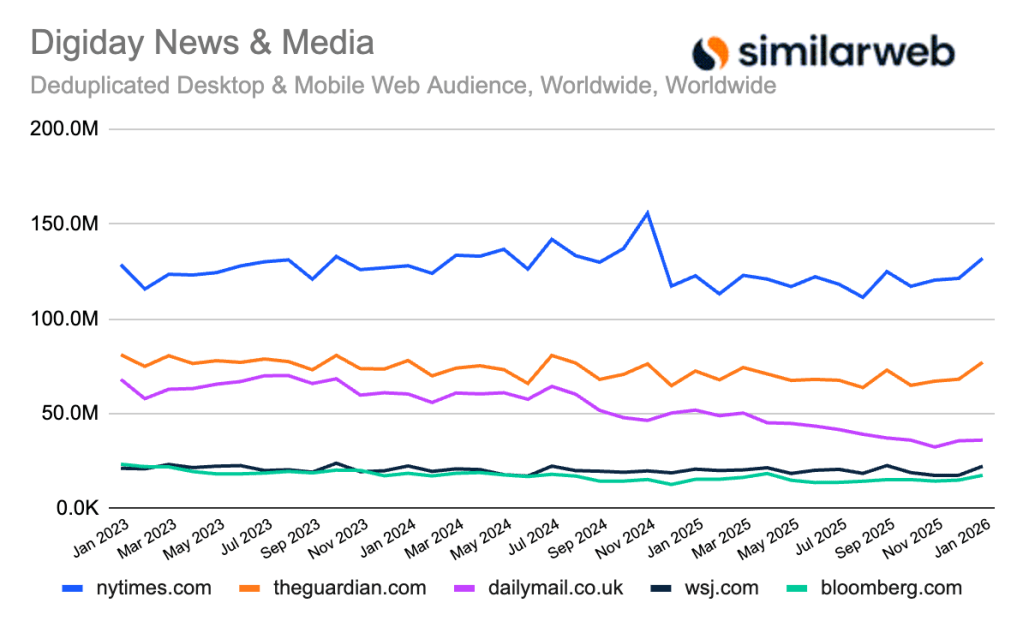
These news publishers continue to grow their subscription businesses despite widespread traffic declines due to changes in search and AI-powered discovery.
Similar Web data shows that all publishers analyzed in this article had positive year-over-year traffic trends, except for Daily Mail, which saw a 30.5% decline in traffic. (David Kerr, senior insights manager at data analytics firm SimilarWeb, said the data is based on deduplicated audience numbers that account for the overlap between unique desktop and mobile web visitors.) Publishers with paywalls are less susceptible to referral traffic erosion, and the Daily Mail’s paywall is less restrictive than other sites.
Traffic in January was up 7.5% year-on-year for the New York Times, 6.4% for the Guardian, 7.4% for the Wall Street Journal, and 13.8% for Bloomberg.
However, if you look at the past 12 months’ numbers (smoothed out the monthly changes in traffic), the picture is not very positive. Over the past 12 months, the New York Times has seen a 9.4 percent drop in traffic, the Guardian 4.3 percent, the Daily Mail 26.6 percent and Bloomberg 6.2 percent. Looking at the numbers, only The Wall Street Journal saw a 0.9 percent increase in traffic.
Berita Terkini
Berita Terbaru
Daftar Terbaru
News
Berita Terbaru
Flash News
RuangJP
Pemilu
Berita Terkini
Prediksi Bola
Togel Deposit Pulsa
Technology
Otomotif
Berita Terbaru
Slot Demo Gratis Tanpa Potongan 2025
Slot yang lagi gacor
Teknologi
Berita terkini
Berita Pemilu
Berita Teknologi
Hiburan
master Slote
Berita Terkini
Pendidikan
Resep
Jasa Backlink
One Piece Terbaru